
The Hiller Foundation

Founding of the Hiller Research Center by Heinrich Heine University Düsseldorf, the Faculty of Medicine, University Hospital Düsseldorf, and the Hiller Foundation on January 9, 2015.
Rheumatic diseases were already among the most common, most expensive, and least researched illnesses in Germany in 2007 — this was the conclusion of the “Roadmap for the Federal Government’s Health Research Program.” For historical reasons, rheumatology research had largely been located outside of medical faculties; dedicated chairs and research institutions were almost entirely absent.
Brigitte and Werner Hiller responded to this gap: in 2008 they founded the Hiller Foundation, followed in 2015 — through a founding agreement between the foundation, the medical faculty, Heinrich Heine University, and Düsseldorf University Hospital — by the Hiller Research Center for Rheumatology. The strategy was clear from the outset: not temporary projects, but something lasting. According to foundation law, the funding is intended to be “permanent.”
Today, the Hiller Research Center, together with the Clinic for Rheumatology, is a leading rheumatology center in Germany. This assessment by external reviewers has been confirmed by decisions of the state of North Rhine-Westphalia and the Fraunhofer Society to establish a Fraunhofer Center for Tissue Research in cooperation with rheumatology in Düsseldorf.
The research center investigates systemic rheumatic diseases using innovative experimental methods and simultaneously pursues three goals: prevention, early treatment, and rehabilitation. Research, clinical practice, and teaching are structurally integrated. From 2015 to 2022, the center was headed by Prof. Dr. med. Matthias Schneider, and since then it has been led by Prof. Dr. med. Jörg Distler, Director of the Clinic for Rheumatology at Düsseldorf University Hospital.
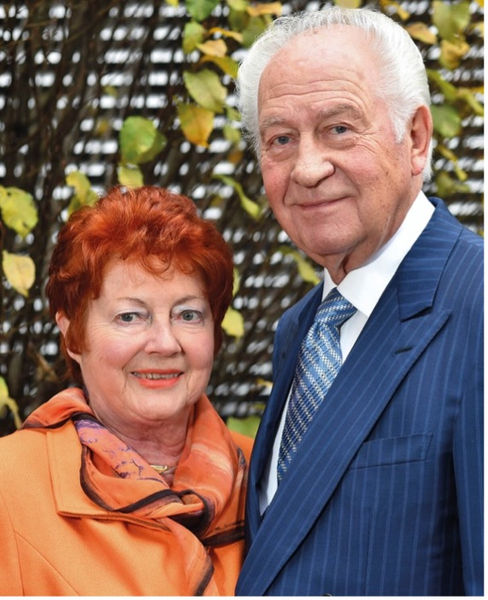
Brigitte and Werner Hiller in 2020 at the award ceremony of the Kussmaul Medal of the German Society for Rheumatology
Brigitte and Werner Hiller
The Founders
Werner Hiller
Brigitte Hiller
Edeltraud Krings
The Hiller Foundation is a purely funding foundation: it finances research and infrastructure without conducting its own scientific projects. With the establishment of the research center in 2015, the creation of an independent Clinic for Rheumatology as well as a professorship in rheumatology at Düsseldorf University Hospital was linked; the director of the clinic was also to serve as director of the research center. All of these goals were achieved within just a few years.
The founding couple’s principle was structural rather than episodic: not start-up funding that expires after a few years, but an institutional framework that sustainably supports research, clinical practice, and teaching.

Brigitte and Werner Hiller in 2021 at the award ceremony conferring honorary senator status by Heinrich Heine University Düsseldorf

Werner Hiller and Edeltraud Krings, honorary member of the Board of the Hiller Foundation, at the celebration marking the tenth anniversary of the Hiller Research Center in June 2025
The commitment of Brigitte and Werner Hiller has been widely recognized in public — always without their involvement. The naming of the research center after them had to be pressed upon Werner Hiller; all honors were bestowed upon the couple without their prior knowledge.
In 2020, the German Society for Rheumatology awarded them the Kussmaul Medal - for achievements that have had a decisive impact on rheumatology in Germany. In 2021, Heinrich Heine University Düsseldorf conferred upon them the titles of Honorary Senator. In 2024, Federal President Frank-Walter Steinmeier awarded them the Order of Merit of the Federal Republic of Germany (Federal Cross of Merit on Ribbon).
Brigitte and Werner Hiller are modest individuals who have never sought public attention. What they have accomplished, however, can be clearly stated: civic engagement in the truest sense of the word — selfless, strategically conceived, and designed for the long term.

Signing of the expanded agreement for the Hiller Research Center between Heinrich Heine University Düsseldorf, the Faculty of Medicine, University Hospital Düsseldorf, and the Hiller Foundation on November 4, 2019.